

Barrio El Palmar
Special Situation for U.S. Visitors
Overview After Presidents Trump and Biden
Americans have had two choices, and the choices determines both activities in Cuba and the route to get there.
To fly directly from the U.S. to Cuba, you must qualify under one of 12 specific reasons for authorized travel for U.S. citizens and residents, such as journalists, family visitation, and education.
Trump took away the category of legal travel to Cuba that created a travel surge for Americans in 2016 and 17. The individual, self-directed people-to-people justification for travel was abolished by Trump officially on November 9, 2017. Later he always withdrew the group people-to-people category. The later were tours, some by private companies and others by organizations such as alumni associations, arts groups, and steam train aficionados. Groups from the U.S., and only those from U.S., were required by Cuba to be run by its own travel agencies. No matter the purpose of the tour, each visited schools, clinics, and activities set up by the Cuban government. Few who knew the really of group people-to-people tours, morned their passing.
For many Americans, however, a new legal avenue is the category of Support for the Cuban People According to new Treasury regulations this travel of individuals and non-governmental organizations that enhance contact with the Cuban people and promote the Cuban people’s independence from Cuban authorities. 31 CFR § 515.574, 11/09/2017.
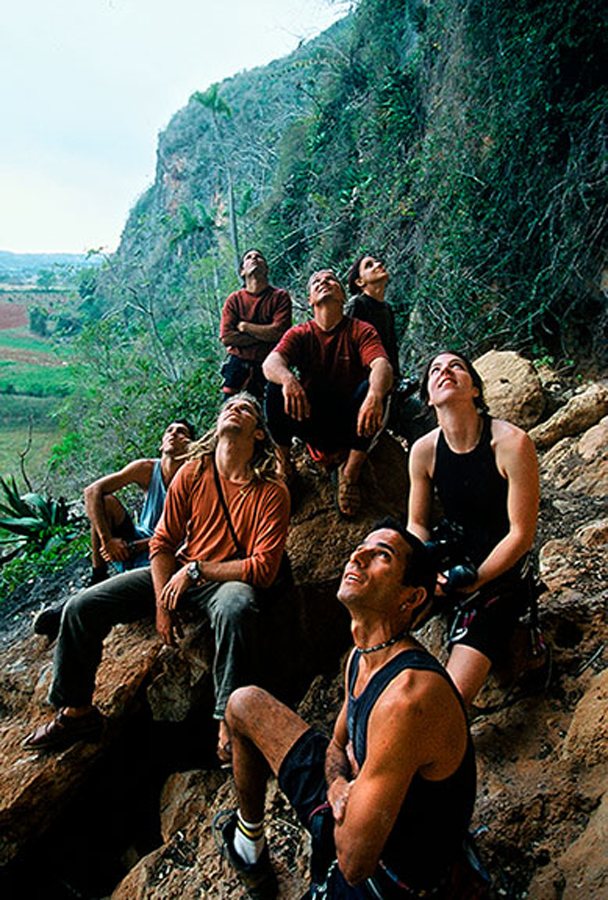
Cubans and visitors rubbernecking at Wasp Factory. Beth Wald
The second option is to travel to Cuba from a third country, such as through Canada, Mexico, and the Caribbean. The U.S. will probably never discover that you went to Cuba. Since 2008, almost no one has been fined for illegal travel to Cuba.
If somehow you blow it and are caught, either years later or when you re-enter the U.S., you may be asked to justify your travel to Cuba, You can still claim that you qualified under one of the 12 categories, such a Support for the Cuban People. The same rule apply whether you travel to Cuba directly from the U.S. or from somewhere else. The difference is that with the third-country route you might never be asked.
Even if don’t qualify for legal travel, you can say nothing and force the U.S. government to prove that you did not qualify to travel to Cuba. The U.S. has few ways to investigate or prove what you did was illegal. If asked directly by a U.S. immigration or custom official if you went to Cuba, do not lie. Admit you were in Cuba, but then, don’t say anything more. Politely refuse to say more.
To prosecute you, the government must get the information from you! If you say nothing, no phony excuses, no justifications, nada, the ICE agent may get upset, and you may get the full, tear-your-bags-apart search, but in the end, the case goes nowhere. Defendants do that every day in ordinary criminal courts, but very few travelers have been willing to take the same approach in travel to Cuba. (The author did in 2003 and has never heard from the U.S. government again.)
The Structure, Language, and Stupidity of U.S.Travel Restrictions
For over 50 years, travel to Cuba by U.S. citizens and residents has been limited by the United States government. For most of the last two decades, Cuba has been the only country on earth that Americans are prohibited from visiting by their government. Nuclear-armed North Korea or Iran, no problem. Want to mix with pirates in Somalia? Go and the U.S. government will spend big bucks in attempted rescues. War-torn Afghanistan or the Northwest Territories in Pakistan, go for it.
But get caught returning from what’s still standing of the last throws of failed communism in a powerless, banana republic, and the U.S. government threatens Americans with 10 years imprisonment and fines of $250,000 for individuals and $1,000,000 for businesses. The Bush Administration was the last to waste time and millions on enforcing the law.
The travel restrictions result from a century old law grotesquely named “The Trading With The Enemy Act.” Every year, U.S. presidents sign an executive order naming Cuba an enemy of the United States.

Rapping with tobacco farmers Paquito and Bebo Calzada
Since the idea is to squeeze an enemy financially, it prohibits Americans from spending money in Cuba by engaging in ”travel related expenditures” or buying anything from or selling any thing to Cuba, It is enforced by the Treasury Department, not the State Department. If permitted to go, the Treasury Department technically grants you a “license” to spend money in Cuba. It isn’t a permission to go or a visa.
The Treasury Department says ordinary tourism is banned. Instead there are 12 authorized categories of travel for specific reasons, like journalism, family visitation, and education. The rules of each category are technical, usually ambiguous and leave you in doubt.
And to complicate matters further, the Treasury regs make categories either general or specific, and these change with each administration.
A specific license means you submit a request to Treasury (to the Office of Foreign Assets Control) and then wait months or years (really) for a response. Under Bush most categories of licenses were specific. You applied and waited and waited. If you succeeded, however, at least you knew before that your trip was legal.
A general license means that the U.S. lets you decide if you can fit your travel into one of the 12 categories. You make the decision, and then you just go. Now, with normal commercial flights, you check a box when booking. That’s it.
Anytime afterwards, however, when you re-enter U.S. or years later, Treasury can ask that you prove that you qualified in one of the 12 categories. If you can’t, you can be prosecuted in court but usually in an administrative proceeding and fined.
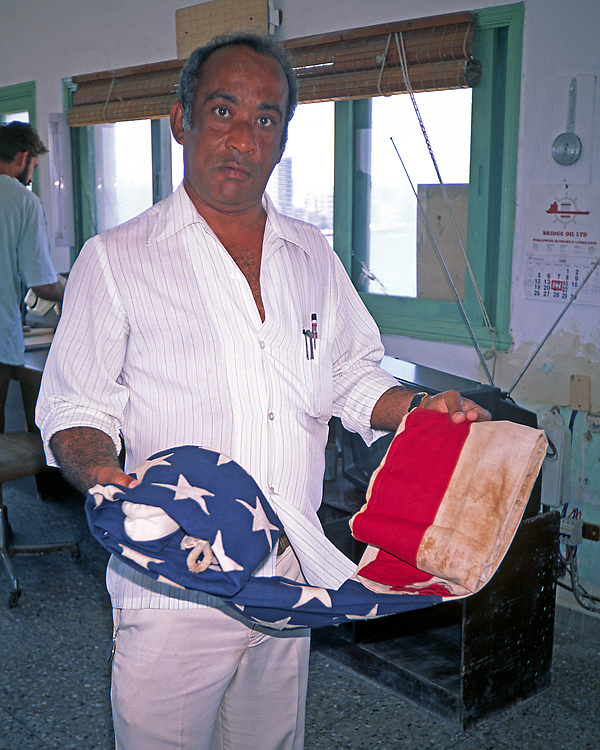
Havana Habor Master and long unused U.S. flag
Obama changed most categories to general licenses, which greatly eased all restrictions. That plus never asking anyone for justification pretty much opened travel to Cuba. Switching everything to general license with zero enforcement makes the categories and rules inconsequential. You can say you’re a journalist or that you went to visit your mother who is Cuban.
So much for the media humbug about removing the individual people-to-people category. The real stories isn’t the rules but that almost a year into the Trump administration, the policy of non-enforcement of the general licenses continue.
For the risk-adverse, however, general license means that you don’t know in advance if you travel it is legal. You can’t ask Treasury. It will say it is up to you to read, interpret, and obey the rules under a general license. You can’t even ask for a specific license if it’s the general license category. You must take your chances, but if there is never any follow-up or enforcement, it isn’t much of a risk.
In Trump’s first year, there is no indication that he will shift to enforcement. The U.S. government has, however, nine years of records of Americans who have signed statements claiming that they qualified for legal travel to Cuba. A mass-mailer demanding proof or face a fine would reek havoc.
On the Cuban side, the situation is much clearer. Cuba welcomes tourists, including those from the United States. In general, travel to and within Cuba is not restricted, although there are many harsh, incomprehensible restrictions on the Cubans with whom tourists may travel, stay, and eat.


